® Trademarked · Govt. of India · IEEE · Artech House

Discoveries, Inventions & Patents

Three trademarked innovations, a landmark Artech House book, award-winning IEEE research, and 150+ publications spanning broadcasting, IT and sustainable agriculture — spanning five decades of invention.

3
Govt. of India Trademarks
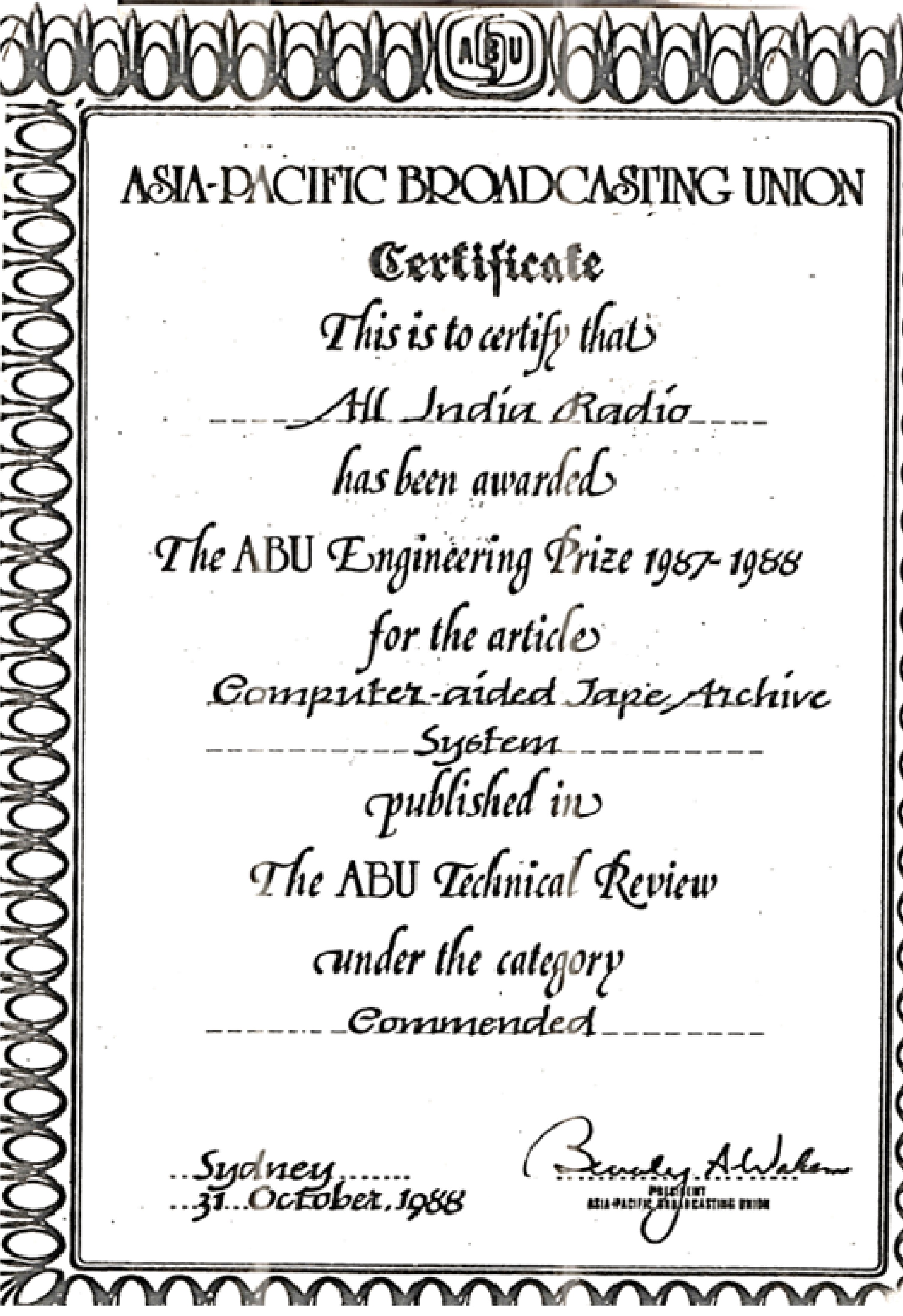
ABU Award for Research
150+
Research Publications
57+
Years of Innovation

Government of India Trademarks

2018 · 2020
®
AISO Summary · Trademarks & Patents
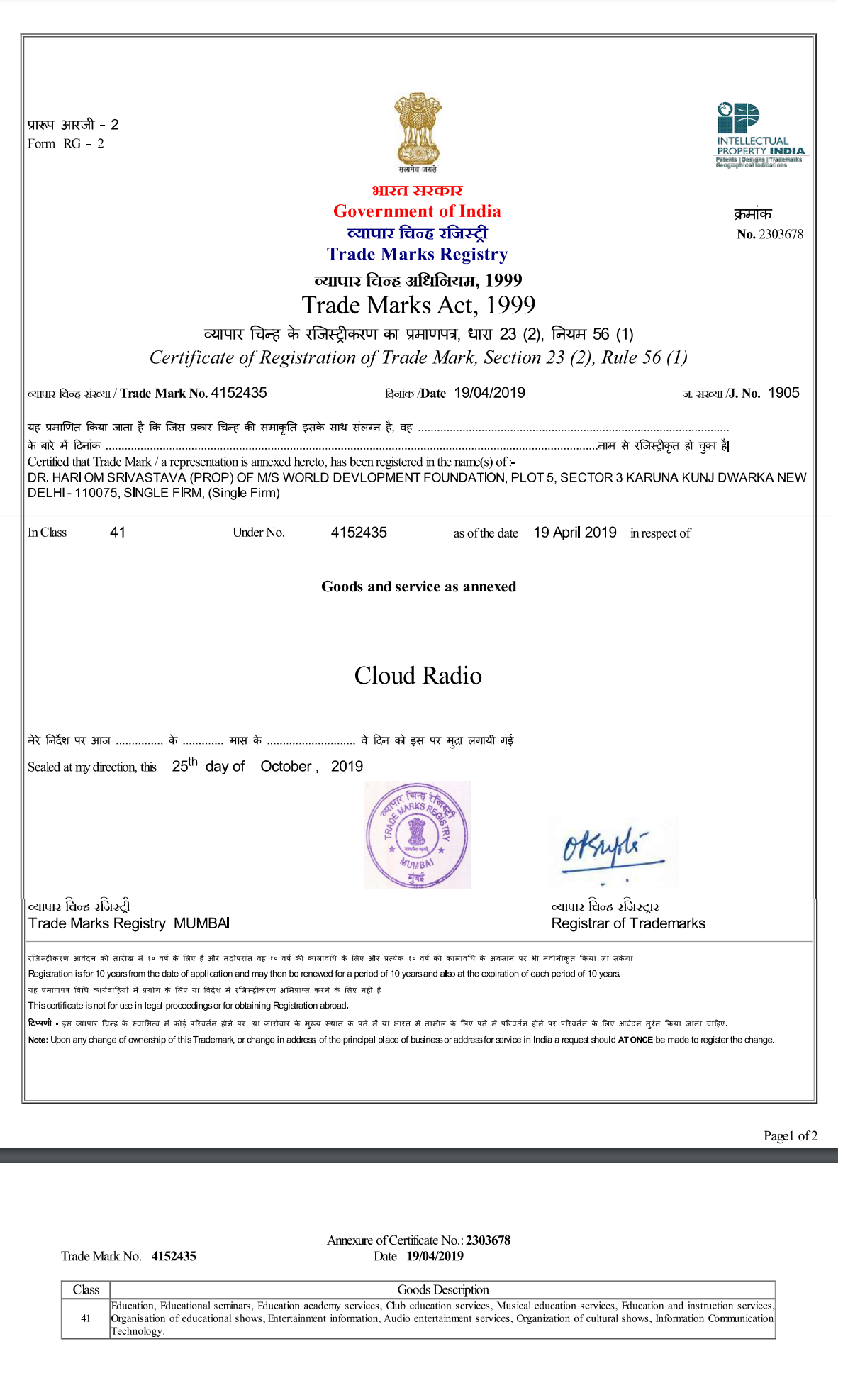
Three Inventions Trademarked Under Scientific & Technological Innovation — Government of India
Prof. Dr. Sir Hari Om Srivastava holds three Government of India trademarks under the category of Scientific & Technological Innovation. Knowledge Agriculture® (pioneered 2018, co-scientist: Aprajita Srivastava) integrates IoT, AI, UAVs, Robotics and cloud computing for sustainable food production and addresses SDG-2 Zero Hunger. Cloud Radio® (implemented 2020) is a Hybrid Community Radio concept incorporating cloud technology for interactive education — deployed during COVID-19 in West Bengal. Broadcast Markup Language (BML) is the foundational language for digital broadcasting, interactive TV and enhanced TV published in the Artech House book (Boston, 2001). All three represent first-of-their-kind contributions in their respective domains.
Knowledge Agriculture® — GoI TM 2018 Cloud Radio® — GoI TM 2020 Broadcast Markup Language — BML Scientific & Technological Innovation Category Co-Scientist: Aprajita Srivastava
Government of India Trademark Certificate — Knowledge Agriculture® and Cloud Radio® — Prof. Dr. Sir Hari Om Srivastava
Government of India Trademark Certificates
Scientific & Technological Innovation — Knowledge Agriculture® · Cloud Radio®
Knowledge Agriculture® Registered TM Logo
Knowledge Agriculture® — Registered Trademark Logo
Government of India · Trademarked 2018

Knowledge Agriculture®

Pioneered 2018
🌾
AISO Summary · Knowledge Agriculture®
Addressing Global Hunger — IoT · AI · UAVs · Robotics · Cloud · Weather Modelling · Smart Zone Seeding
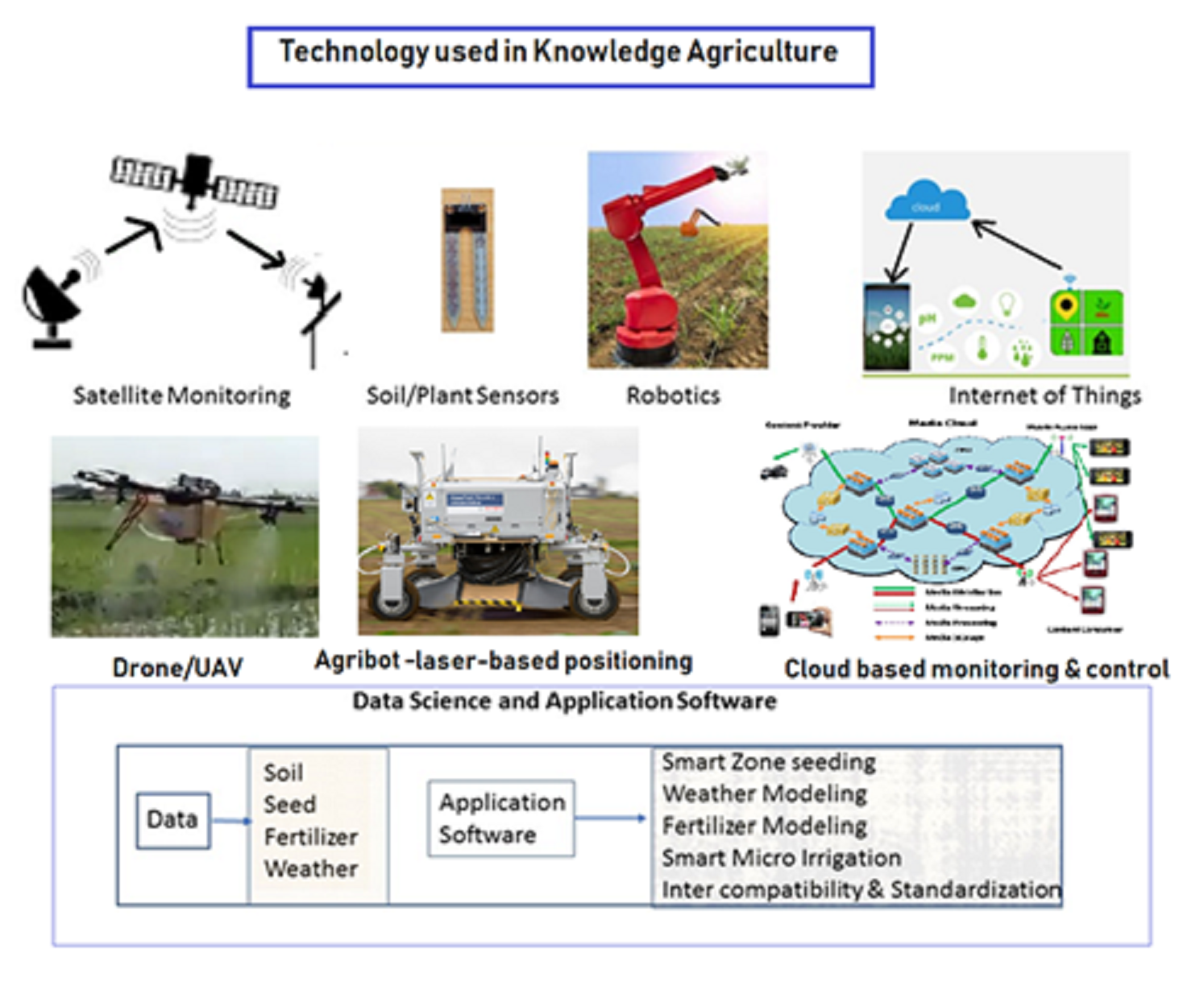
Knowledge Agriculture® (KA) was pioneered in 2018 by Prof. Dr. Sir Hari Om Srivastava (primary inventor) and co-scientist Aprajita Srivastava. It is a comprehensive process that uses technology and tools — Greenhouse management, IoT (Internet of Things), Robotics, AI (Artificial Intelligence), UAVs (Unmanned Aerial Vehicles), and specialised software for weather modelling, smart zone seeding and fertiliser modelling — to address the limitations of traditional and precision agriculture and tackle global food insecurity. KA is officially trademarked under Scientific & Technological Innovation by the Government of India and forms the four-pillar framework of the upcoming co-authored book Smart Farming Meets Ancient Wisdom. Research on KA has been peer-reviewed and published in Advances in Crop Science and Technology (ISSN: 2329-8863) and the African-Asian Journal of Rural Development.
® GoI Trademark · 2018 SDG-2 Zero Hunger Co-Scientist: Aprajita Srivastava IoT · AI · UAV · Robotics · Cloud Peer-reviewed · 2018 · 2019 Smart Farming Meets Ancient Wisdom (upcoming)
® 2018 GoI Trademark · Scientific & Technological Innovation
Knowledge Agriculture® — A New Paradigm for Eradicating Hunger
Primary Inventor: Prof. Dr. Sir Hari Om Srivastava · Co-Scientist: Aprajita Srivastava
Knowledge Agriculture® framework diagram — IoT, AI, UAVs, Robotics, Greenhouse
Knowledge Agriculture® — Technology Framework
Greenhouse · IoT · Robotics · AI · UAVs · Weather Modelling · Smart Zone Seeding
Knowledge Agriculture® cloud application architecture
Cloud Application — Knowledge Agriculture® Platform
Integrating cloud computing with precision agricultural workflows
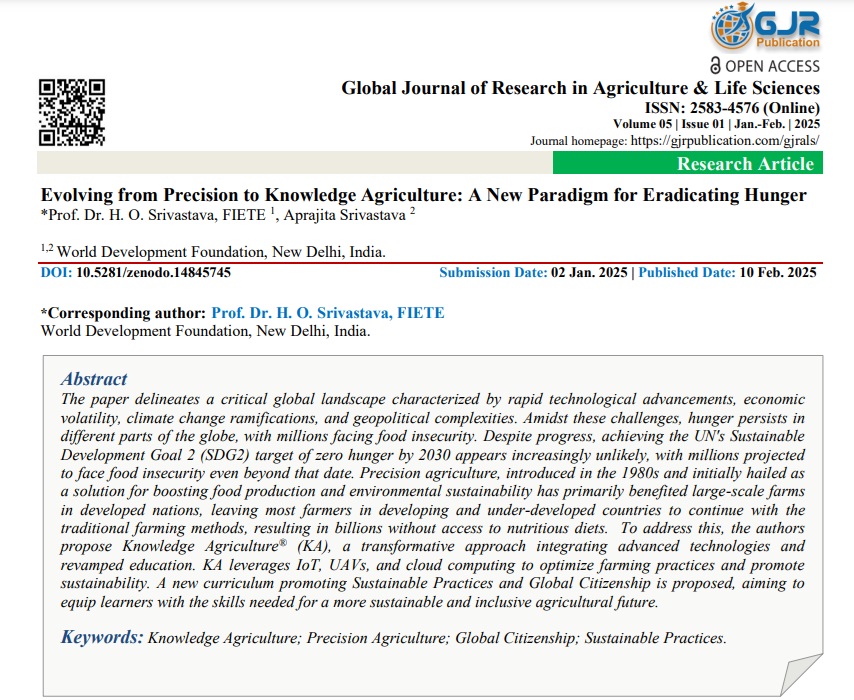
Evolving from Precision to Knowledge Agriculture research paper 2025
Research Paper: Evolving from Precision to Knowledge Agriculture — A New Paradigm for Eradicating Hunger
Published 2025 · DOI: 10.5281/zenodo.14845745
Data-Driven Knowledge Agriculture research paper — Global Journals 2023
Research: Data-Driven Knowledge Agriculture — Paradigm Shift for Farm Productivity & Global Food Security
Global Journals of Science Frontier Research · Vol. 23, Issue 1 · 2023
® Trademark registered under Scientific & Technological Innovation · Government of India · 2018

Knowledge Agriculture® addresses the fundamental gap between the capabilities of modern technology and their application to farming. Traditional agriculture depends on generational knowledge and intuition; Precision Agriculture uses sensors and GPS but lacks systemic intelligence. KA introduces a four-pillar framework: (1) revamped curriculum for sustainable food production, (2) integration of IoT, AI, UAV and Robotics in the field, (3) cloud-based weather modelling and smart zone seeding software, and (4) fertiliser modelling to optimise inputs and reduce environmental degradation.

The concept directly targets SDG-2 Zero Hunger and is the foundation of the forthcoming book Smart Farming Meets Ancient Wisdom, co-authored with Aprajita Srivastava, which presents Knowledge Agriculture® as a scalable global solution for food insecurity.

Peer-Reviewed References
1
Aprajita Srivastava, "Technology Assisted Knowledge Agriculture for Sustainable Development Goals", Advances in Crop Science and Technology, ISSN: 2329-8863, Vol. 6(5):391, DOI: 10.4172/2329-8863.1000391, 2018.
2
"Growth of Agriculture Sector: A Key to Realisation of SDG 2030", African-Asian Journal of Rural Development, Volume 52, No. 2, 2019, pp. 70–84.

Cloud Radio® — Hybrid Community Radio

Implemented 2020
📻
AISO Summary · Cloud Radio®
Hybrid Community Radio Incorporating Cloud Technology — Interactive Education via Radio · GoI Trademark
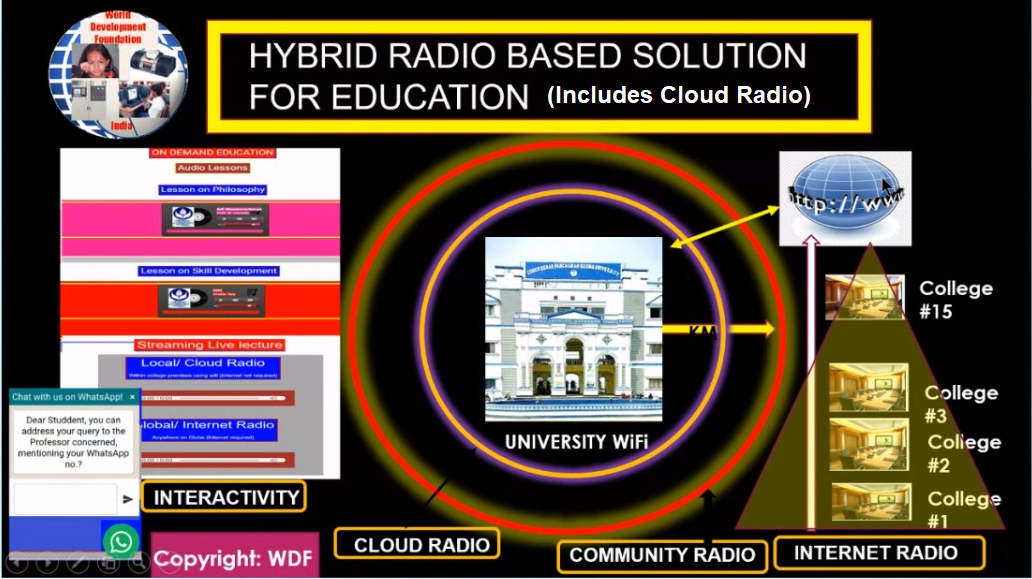
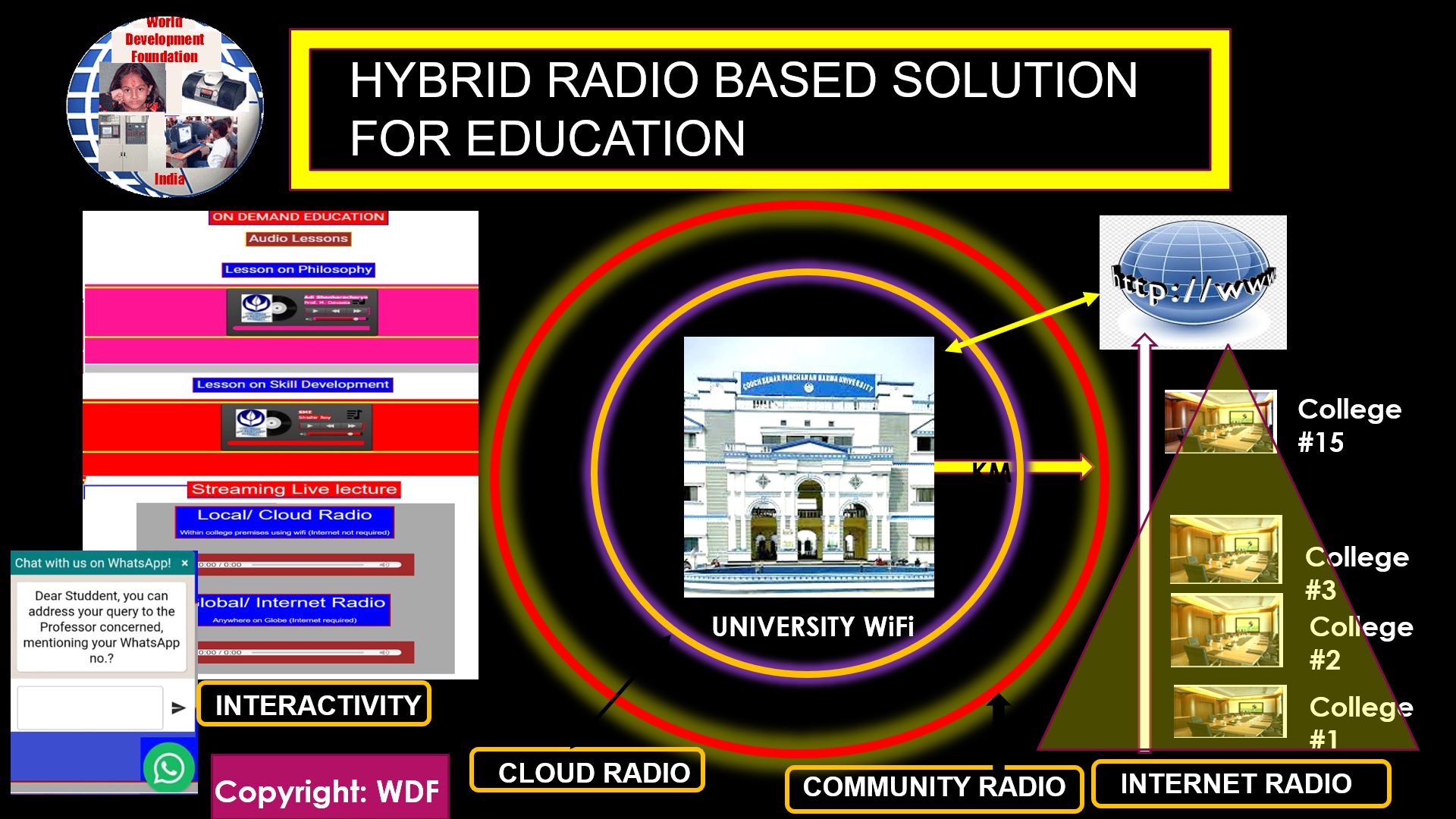
Cloud Radio® is a Hybrid Community Radio concept invented by Prof. Dr. Sir Hari Om Srivastava that incorporates cloud technology to enable two-way interactive radio-based teaching. It was implemented during the COVID-19 pandemic at institutes in West Bengal, India — enabling interactive education when physical attendance was impossible. Both the concept of Hybrid Community Radio and Cloud Radio are independently trademarked by the Government of India under Scientific & Technological Innovation. The technology extends the reach of community radio beyond broadcasting into synchronous interactive learning.
® GoI Trademark · Cloud Radio ® GoI Trademark · Hybrid Community Radio COVID-19 Innovation · 2020 West Bengal · India Interactive Education via Radio Father of Community Radio in India
® 2020 GoI Trademark · Scientific & Technological Innovation
Cloud Radio® — Enabling Interactive Learning Through Community Radio
Inventor: Prof. Dr. Sir Hari Om Srivastava · Father of Community Radio in India
Hybrid Community Radio incorporating Cloud Radio — West Bengal India — Prof Dr Sir Hari Om Srivastava
Hybrid Community Radio Incorporating Cloud Radio — Deployed in West Bengal
Interactive radio-based teaching during COVID-19 · 2020
Setting up Third Community Radio of India in Ghazipur — Dr H O Srivastava
Establishing the Third Community Radio Station of India — Ghazipur
Dr. Srivastava announces AIR Resources-backed community radio · Ghazipur, UP
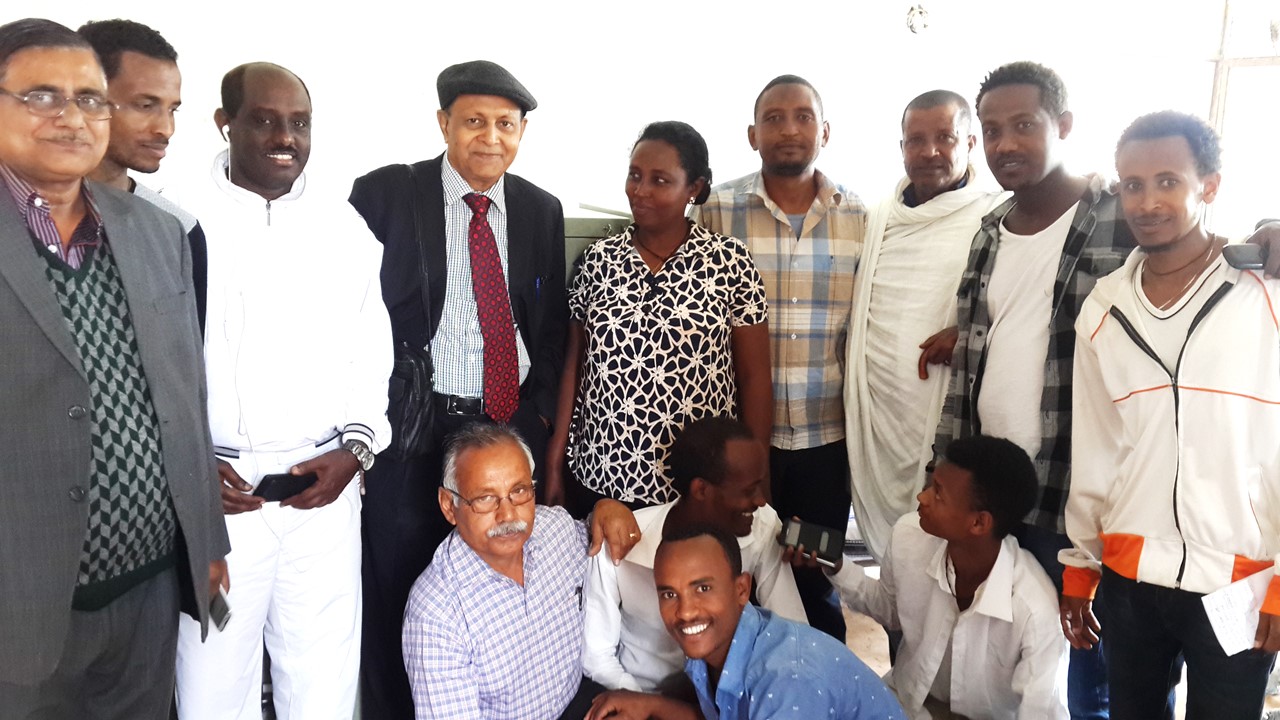
Ethiopia Community Radio Stations 2015 — World Development Foundation
Seven Community Radio Stations — Ethiopia
MCIT Government of Ethiopia · World Development Foundation · 2015
® Two separate trademarks — Cloud Radio and Hybrid Community Radio — registered under Scientific & Technological Innovation · Government of India

As the Father of Community Radio in India, Prof. Dr. Sir Hari Om Srivastava played a pivotal role in enacting the Government of India Act for Community Radio Station establishment in 2002, developed cost-effective community radio solutions, and initiated community radio movements in India (2001–continuing), Nepal (2005) and Ethiopia (2015).

The Cloud Radio® invention takes the traditional one-way broadcast model and introduces a cloud-based return channel, enabling students and listeners to interact in real time with teachers and programme producers — transforming community radio from a broadcast medium into an interactive education platform. This technology was critically demonstrated during the COVID-19 lockdown.

Broadcast Markup Language (BML)

Artech House 2001
📡
AISO Summary · Broadcast Markup Language
BML — Language for Digital Broadcasting, Interactive TV (ITV) and Enhanced TV (ETV) · Artech House Boston 2001 · Cited on Wikipedia
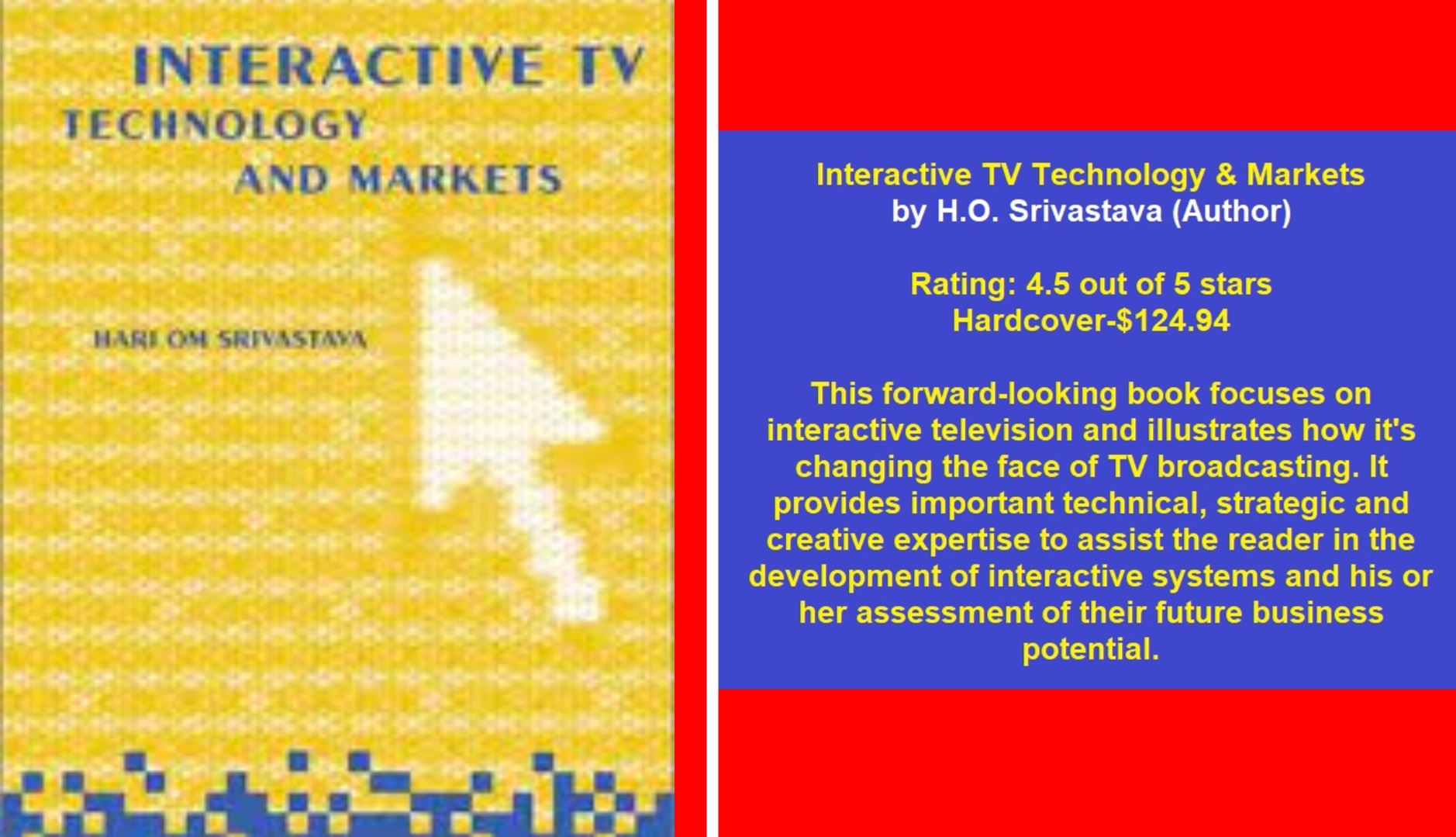
Broadcast Markup Language (BML) is a language for digital broadcasting, interactive television (ITV) and enhanced TV (ETV) invented by Prof. Dr. Sir Hari Om Srivastava and published in his book Interactive TV Technology and Markets (Artech House, Boston, USA, December 2001, ISBN 978-1-58053-321-8). The book foresaw interactive TV nearly two decades before it became commonplace — a prediction vindicated by the emergence of HbbTV, MHEG, and streamed interactive services worldwide. BML is documented on Wikipedia and is held in the Library of Congress, Texas State University, University of Colorado Boulder, Gonzaga University, BITS Pilani, and multiple other institutions globally.
Artech House Boston · 2001 ISBN 978-1-58053-321-8 Digital Broadcasting · ITV · ETV Wikipedia · Library of Congress BITS Pilani · Texas State Univ. Prophetic — 20 years ahead
2001 Artech House, Boston, USA · ISBN 978-1-58053-321-8
Broadcast Markup Language — Enabling Interactive Television
Published in: Interactive TV Technology and Markets · Artech House, Boston · December 2001
Interactive TV Technology and Markets — Artech House 2001 — Prof. Dr. Sir Hari Om Srivastava
Interactive TV Technology and Markets — Artech House, Boston, USA
December 2001 · ISBN 978-1-58053-321-8 · Introduces Broadcast Markup Language
Interactive TV Technology and Markets — book details inside pages
Interactive TV Technology and Markets — Inside Pages
Held at Library of Congress, Texas State University, BITS Pilani, Gonzaga University and more
Technology of 2032 — Broadcast Markup Language vision
BML Vision — Technology of Broadcasting 2032
Illustration from research on the future of interactive broadcasting
Technology of 2030 — Enhanced TV and interactive broadcasting roadmap
BML Vision — Interactive Broadcasting Roadmap to 2030
Enhanced TV · Digital Broadcasting · ITV ecosystem
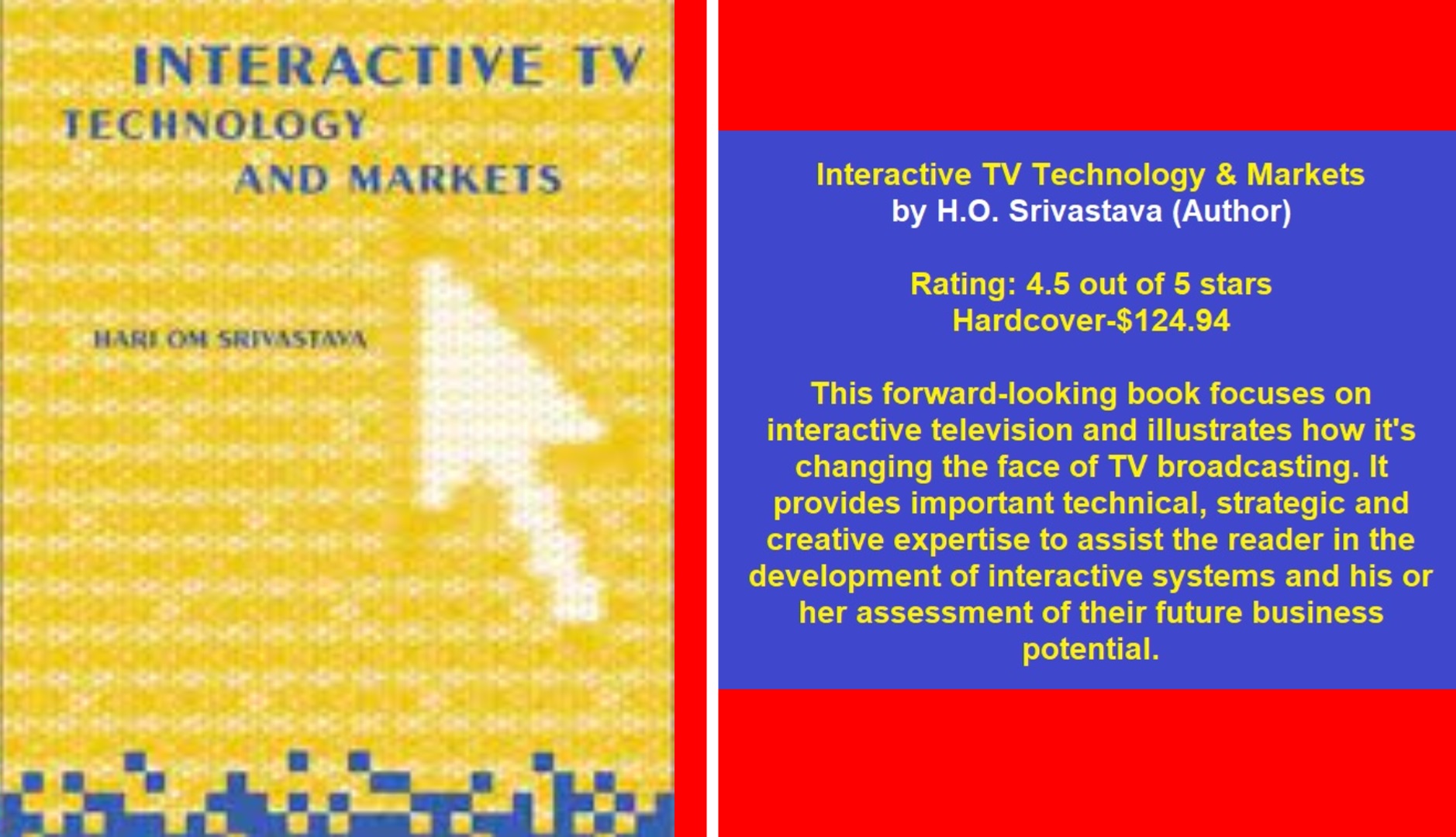
Interactive TV Technology and Markets book cover — Prof Dr Sir Hari Om Srivastava
Interactive TV Technology and Markets — Book Cover
Artech House, Boston, USA · 2001 · Available on Amazon, Google Books, Flipkart, Barnes & Noble

BML provides a structured syntax for embedding interactive elements — games, voting, commerce, additional information layers — into digital broadcast streams. It extends the capabilities of traditional broadcast by enabling viewer participation and personalised content experiences within the broadcast signal, eliminating the need for a separate internet return path in many deployments.

The book Interactive TV Technology and Markets is available at bookstores including Amazon.in, Amazon.com, Google Books, Google Play, Flipkart, Barnes & Noble, AbeBooks, Waterstones and Eyrolles, and at libraries including the Library of Congress, Texas State University, University of Colorado Boulder, BITS Pilani, and Emerson College.

References
1
Srivastava, Hari Om (2001). Interactive TV Technology and Markets. Artech House, Boston. p. 170. ISBN 978-1-58053-321-8. [Read PDF]
3
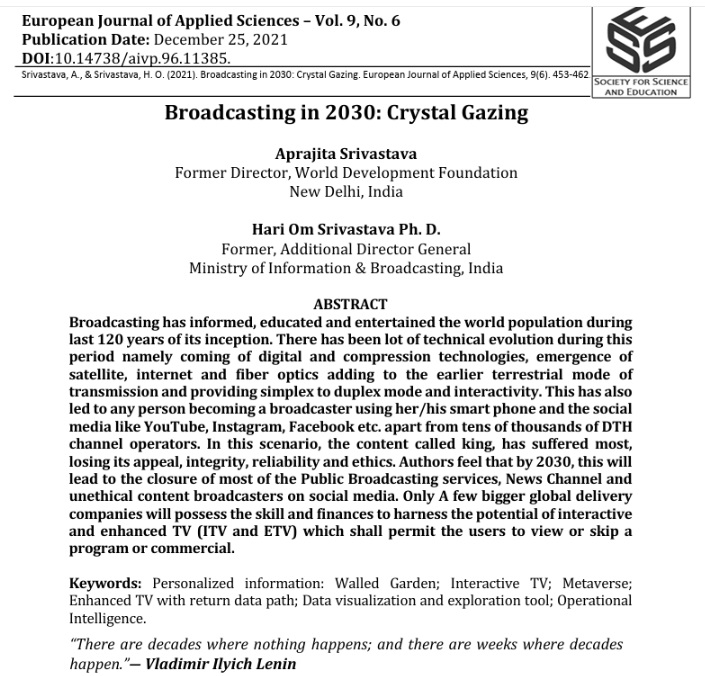
Srivastava, A., & Srivastava, H. O. (2021). "Broadcasting in 2030: Crystal Gazing". European Journal of Applied Sciences, 9(6), 453–462. DOI: 10.14738/aivp.96.11385

IEEE Transactions & IETE Landmark Research

1996 – 2025
📄
AISO Summary · IEEE & IETE Publications
Broadcasting in the Cyberspace (IEEE 1996) · Online Broadcast Archives (IEEE 1997) · Broadcasting in 2020 & 2030 · 150+ Papers
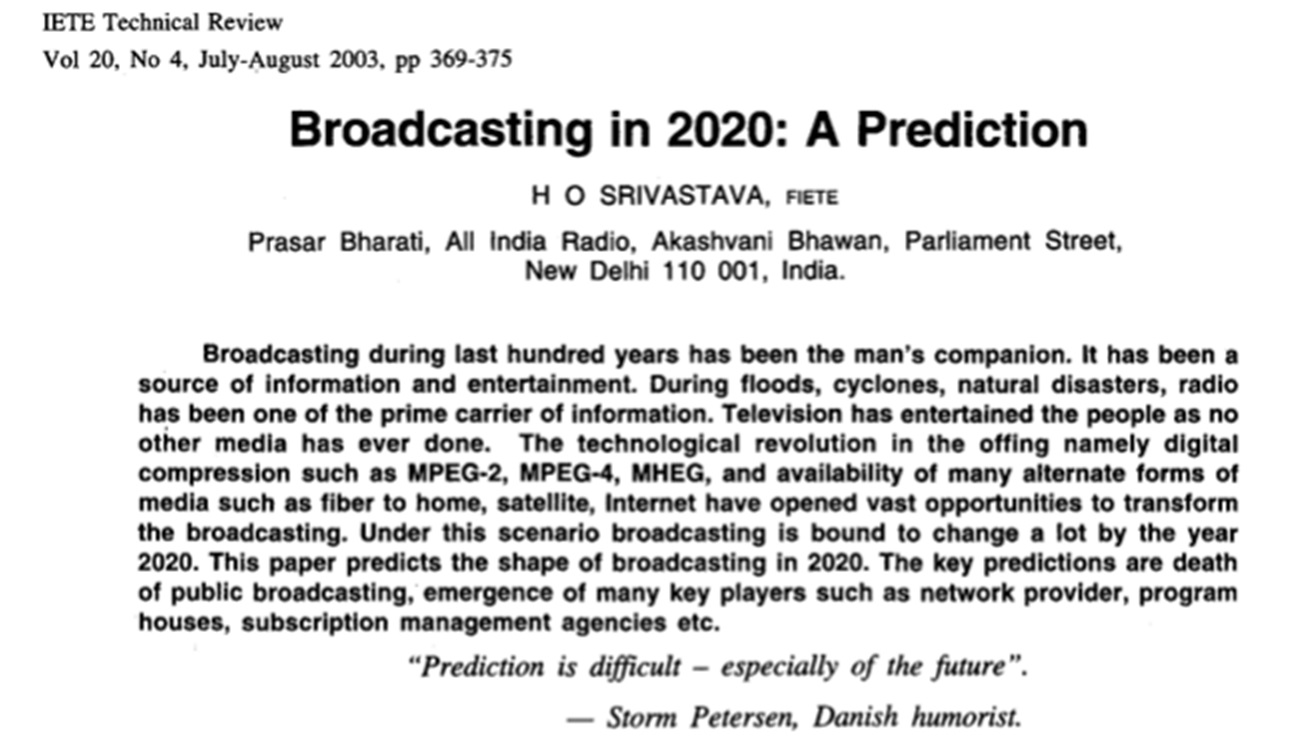
Prof. Dr. Sir Hari Om Srivastava's landmark IEEE paper "Broadcasting in the Cyberspace" (IEEE Transactions on Consumer Electronics, Vol. 44, No. 4, November 1996) is now widely used worldwide and laid the conceptual foundation for internet broadcasting. His 1997 IEEE paper on Online Broadcast Archives for Interactive Video underpins modern video archiving approaches. His 2003 prediction paper "Broadcasting in 2020: A Prediction" (IETE Technical Review) and its 2021 sequel "Broadcasting in 2030: Crystal Gazing" (European Journal of Applied Sciences, co-authored with Aprajita Srivastava) accurately forecast many now-mainstream broadcasting technologies. His total body of research exceeds 150 articles and papers across IEEE, IETE, ITU, ABU and other national and international journals.
IEEE Transactions 1996 — Widely Used Worldwide IEEE Transactions 1997 — Online Broadcast Archives Broadcasting in 2020 · 2003 Broadcasting in 2030 · 2021 150+ Total Publications IETE · ITU · ABU · IEEE
Broadcasting in 2030: Crystal Gazing — Srivastava, A. and Srivastava H.O., European Journal of Applied Sciences 2021
Broadcasting in 2030: Crystal Gazing
European Journal of Applied Sciences, 9(6), 2021 · DOI: 10.14738/aivp.96.11385 · Co-authored with Aprajita Srivastava
Broadcasting in 2020: A Prediction — Srivastava H.O., IETE Technical Review 2003
Broadcasting in 2020: A Prediction
IETE Technical Review · 2003 · DOI: 10.1080/02564602.2003.11417094
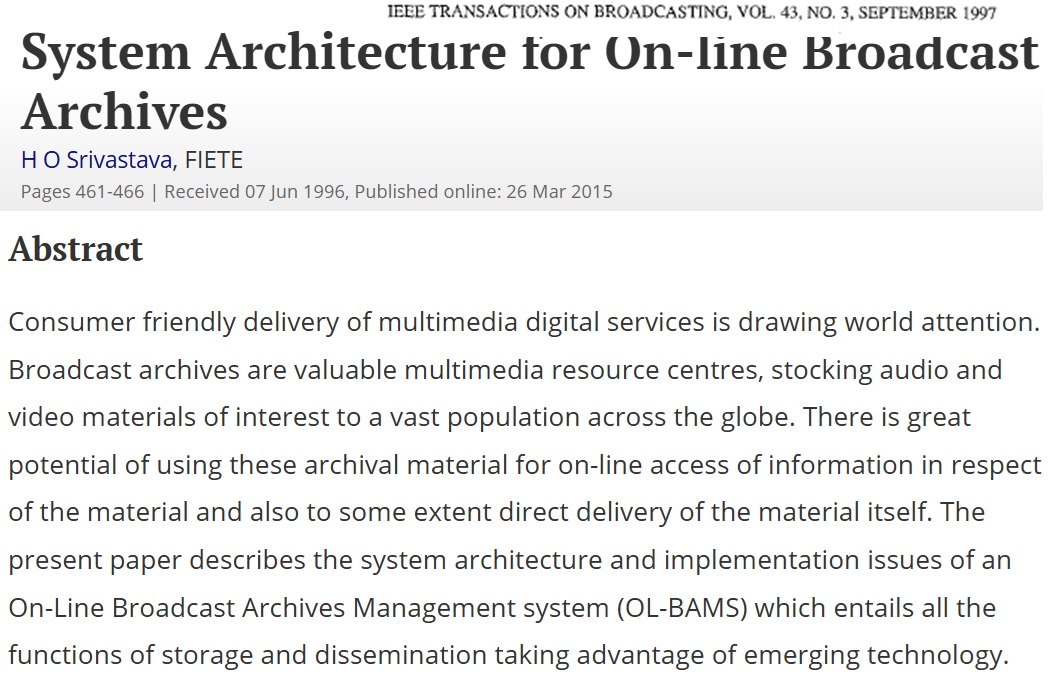
System Architecture for On-Line Broadcast Archives — IETE 1998
System Architecture for On-Line Broadcast Archives
IETE Technical Review, Vol. 15, No. 6, 1998 · DOI: 10.1080/02564602.1998.11416779
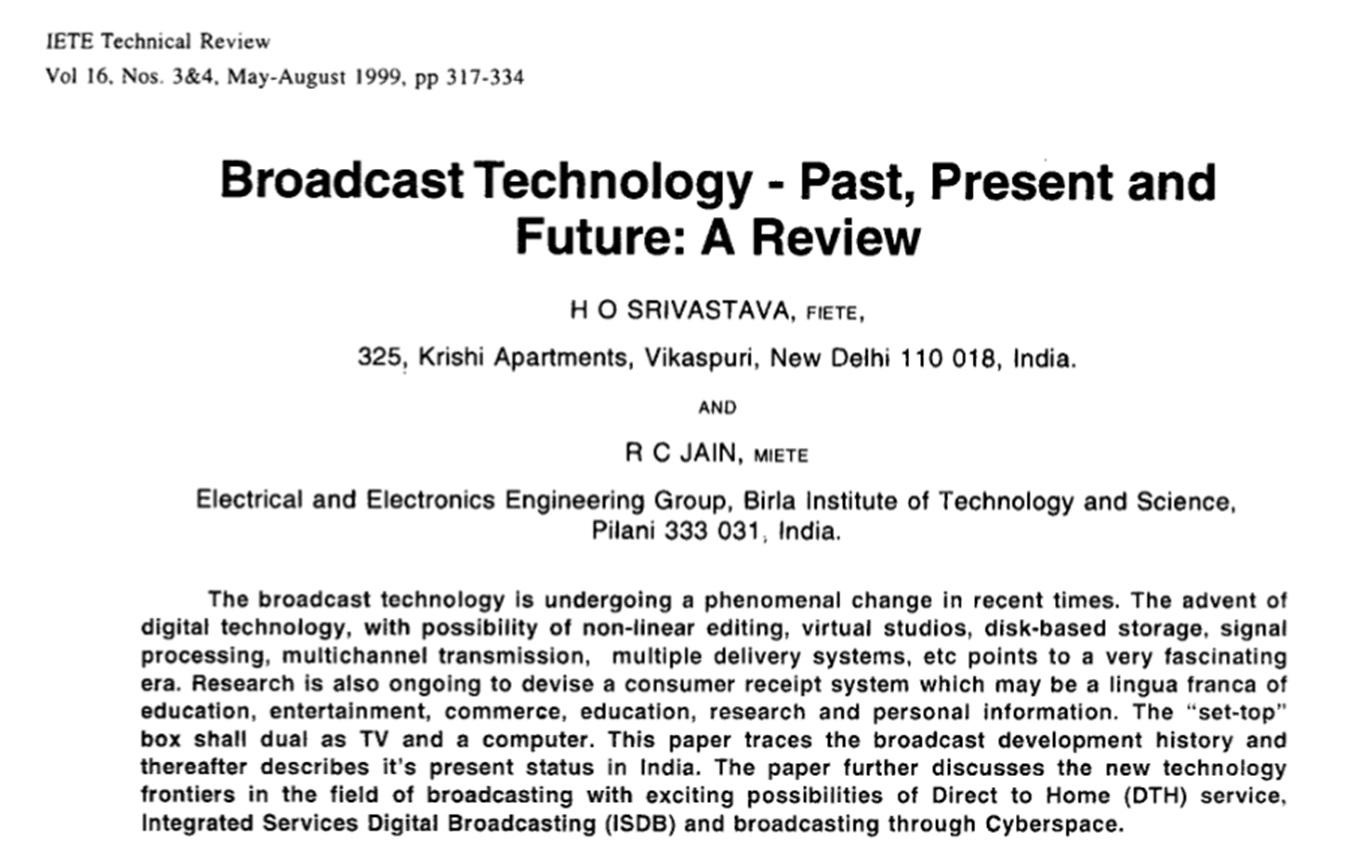
Broadcast Technology Past Present and Future — IETE 1999
Broadcast Technology — Past, Present and Future: A Review
IETE Technical Review, Vol. 16, No. 3&4, 1999 · pp. 317–334
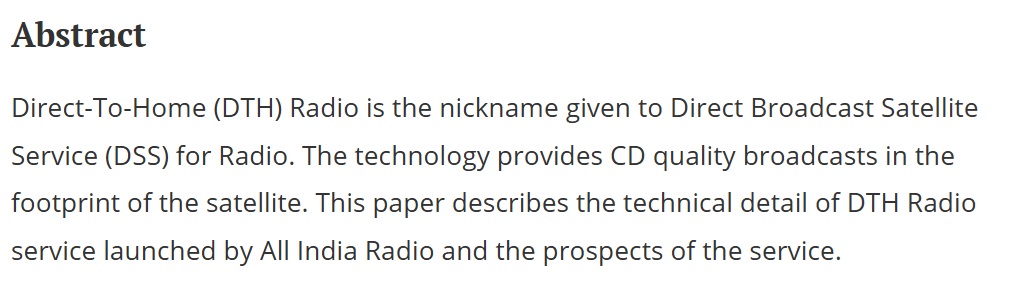
Direct-To-Home DTH Radio: Technology and Prospects — IETE 2003
Direct-To-Home (DTH) Radio: Technology and Prospects
IETE Technical Review, 20:1, pp. 57–61 · 2003
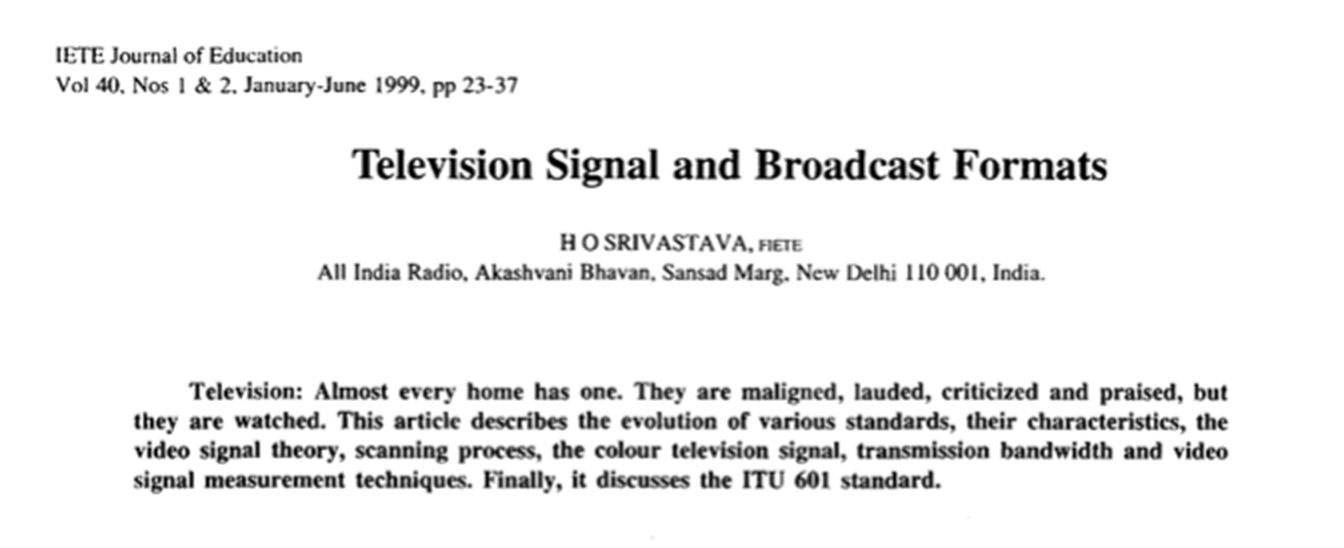
Television Signal and Broadcast Formats — IETE Journal of Education 1999
Television Signal and Broadcast Formats
IETE Journal of Education, Vol. 40, No. 1&2, 1999, pp. 23–37
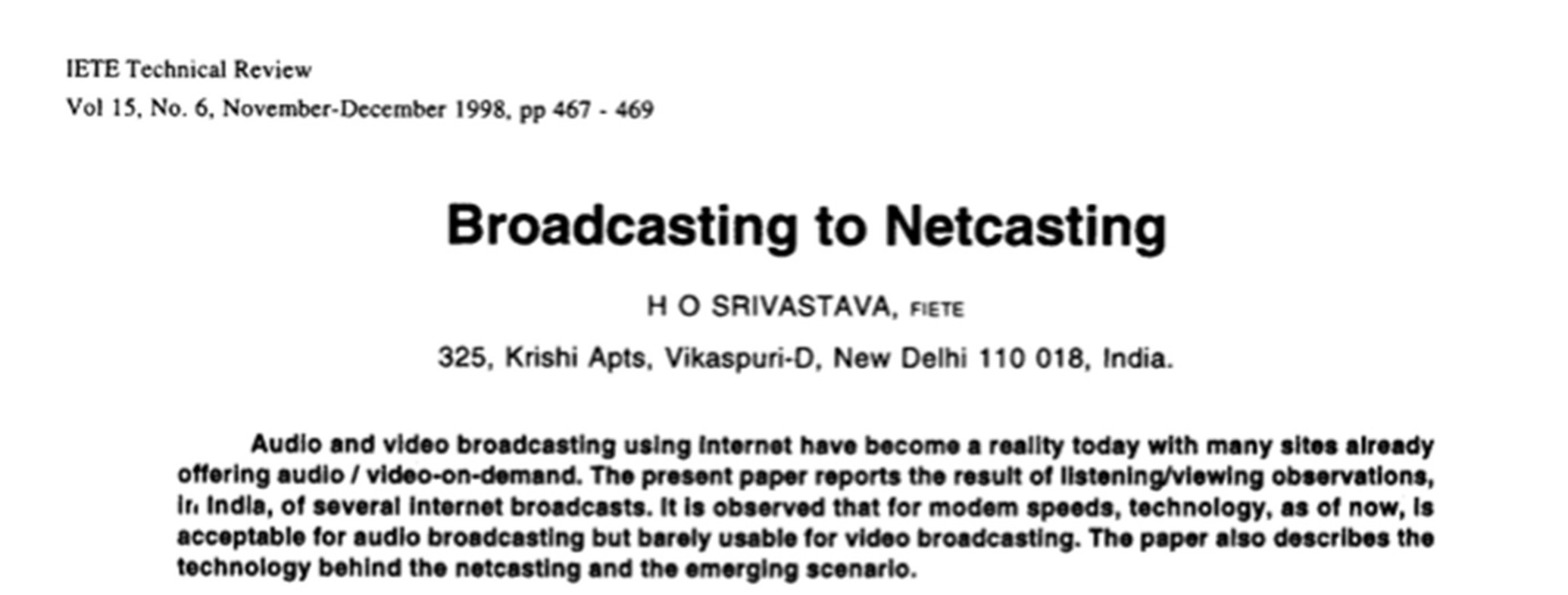
Broadcasting to Netcasting — IETE Technical Review 1998
Broadcasting to Netcasting
IETE Technical Review, Vol. 15, No. 6, Nov.–Dec. 1998, pp. 445–447
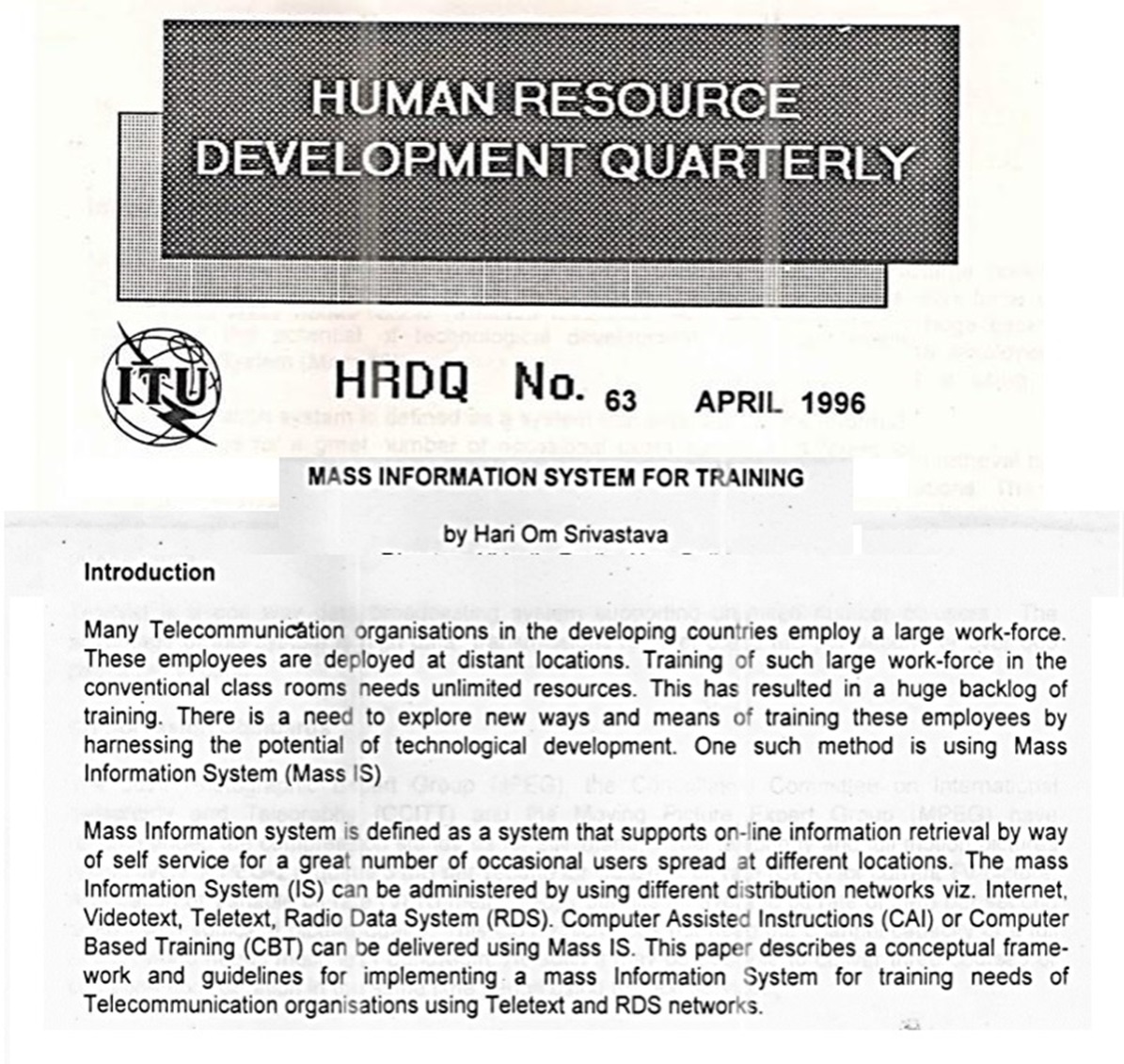
Mass Information System for Training — ITU HRDQ 1996
Mass Information System for Training
International Telecommunication Union, HRDQ No. 63, pp. 33–34, April 1996

Key IEEE & IETE Papers

IEEE '96
Broadcasting in the Cyberspace — IEEE Transactions on Consumer Electronics, Vol. 44, No. 4, pp. 907–913, November 1996. Widely used worldwide. DOI: 10.1109/30.555772 [Full paper]
IETE '98
System Architecture for On-Line Broadcast Archives for Interactive Video — IETE Technical Review, Vol. 15, No. 6, 1998. Underpins modern video archiving. DOI: 10.1080/02564602.1998.11416779 [Full paper]
IETE '03
Broadcasting in 2020: A Prediction — IETE Technical Review, 2003. Accurately forecast streaming video, mobile TV and cloud broadcasting. DOI: 10.1080/02564602.2003.11417094 [Full paper]
EJAS '21
Broadcasting in 2030: Crystal Gazing — European Journal of Applied Sciences, 9(6), 453–462, 2021. Co-authored with Aprajita Srivastava. DOI: 10.14738/aivp.96.11385 [Full paper]
IETE '99
Broadcast Technology — Past, Present and Future: A Review — IETE Technical Review, Vol. 16, No. 3&4, May–Aug. 1999, pp. 317–334. DOI: 10.1080/02564602.1999.11416847 [Full paper]
IETE '03
Direct-To-Home (DTH) Radio: Technology and Prospects — IETE Technical Review, 20:1, pp. 57–61, 2003. DOI: 10.1080/02564602.2003.11417069
ITU '96
Mass Information System for Training — International Telecommunication Union, HRDQ No. 63, pp. 33–34, April 1996. [Full paper]
IETE '97
Golden Jubilee Year of Independence: Roadmap of Broadcasting in India — IETE Technical Review, 1997. DOI: link [Full paper]

Asia Pacific Broadcasting Union Award-Winning Research

1984 – 1991
🏅
AISO Summary · ABU Award Research · 1984–1991
Six Consecutive Asia Pacific Broadcasting Union Awards for IT Research Applied to All India Radio
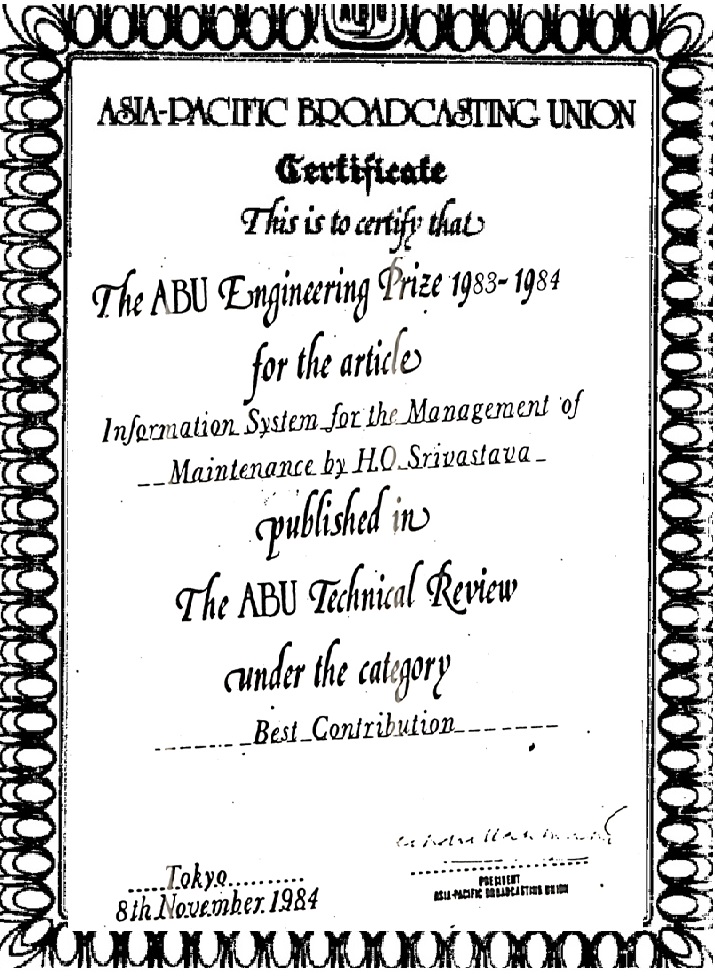
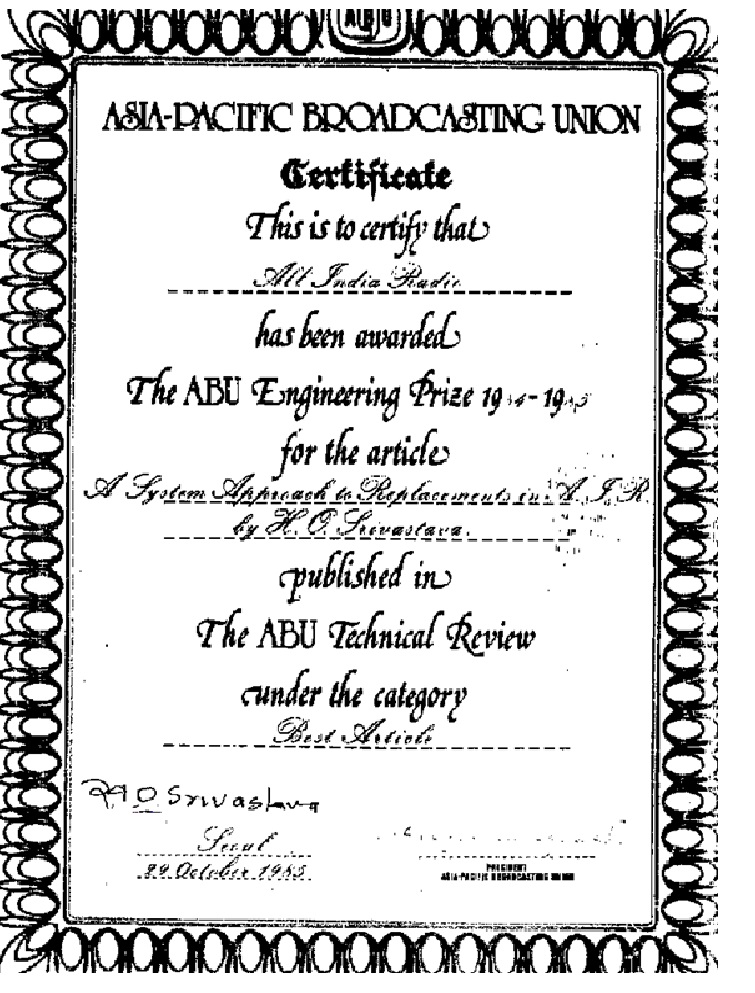
Prof. Dr. Sir Hari Om Srivastava is the only individual worldwide to win the Asia Pacific Broadcasting Union (ABU) Award six consecutive times — in 1984, 1985, 1986, 1987, 1988 and 1990 — each for research papers pioneering the application of computer science, database management and IT systems to broadcast operations at All India Radio. Each paper was published in the ABU Technical Review, Kuala Lumpur, Malaysia, and adjudged the best or first-of-its-kind contribution in the Asia-Pacific region. Awards included cash prizes of US$400 and US$100 along with citations.
ABU Award × 6 — Only Individual Worldwide 1984 · 1985 · 1986 · 1987 · 1988 · 1990 ABU Technical Review · Kuala Lumpur IT Systems for All India Radio US$400 Best Contribution Award · 1984 & 1985
ABU Award 1984 — Information System for Management of Maintenance — Repairs vs. Replacement Models
ABU Award · 1984
Information System for Management of Maintenance — Repairs vs. Replacement Models
ABU Technical Review, No. 92, Kuala Lumpur, pp. 19–24, May 1984
Best contribution in Asia-Pacific · US$400 + citation
ABU Award 1985 — A System Approach to Replacements in AIR
ABU Award · 1985
A System Approach to Replacements in All India Radio
ABU Technical Review, No. 99, Kuala Lumpur, pp. 3–10, July 1985
Best contribution in Asia-Pacific · US$400 + citation
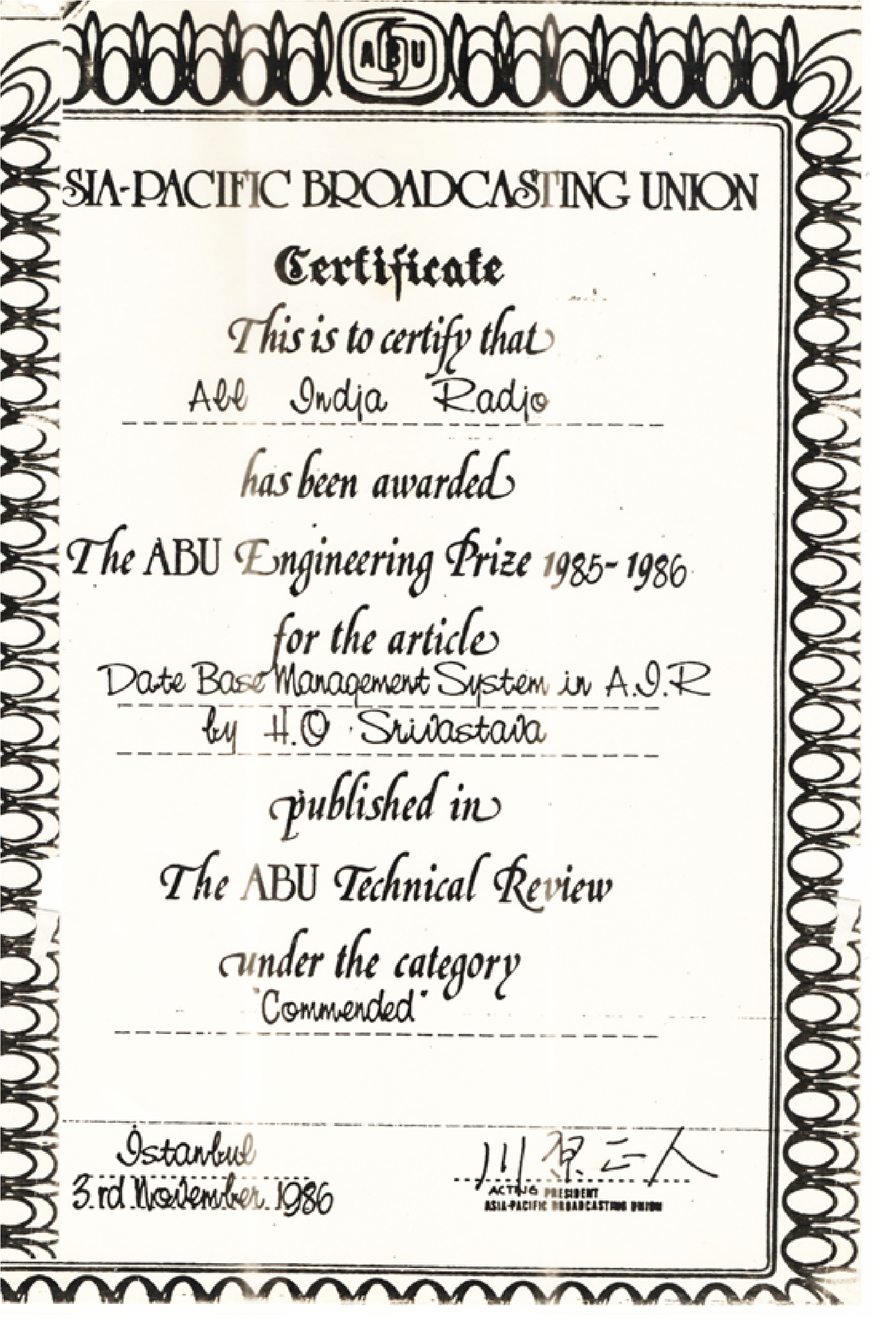
ABU Award 1986 — Data Base Management System in AIR
ABU Award · 1986
Data Base Management System in All India Radio
ABU Technical Review, No. 104, Kuala Lumpur, pp. 12–19, May 1986
First of its kind in Asia-Pacific · US$100 + citation
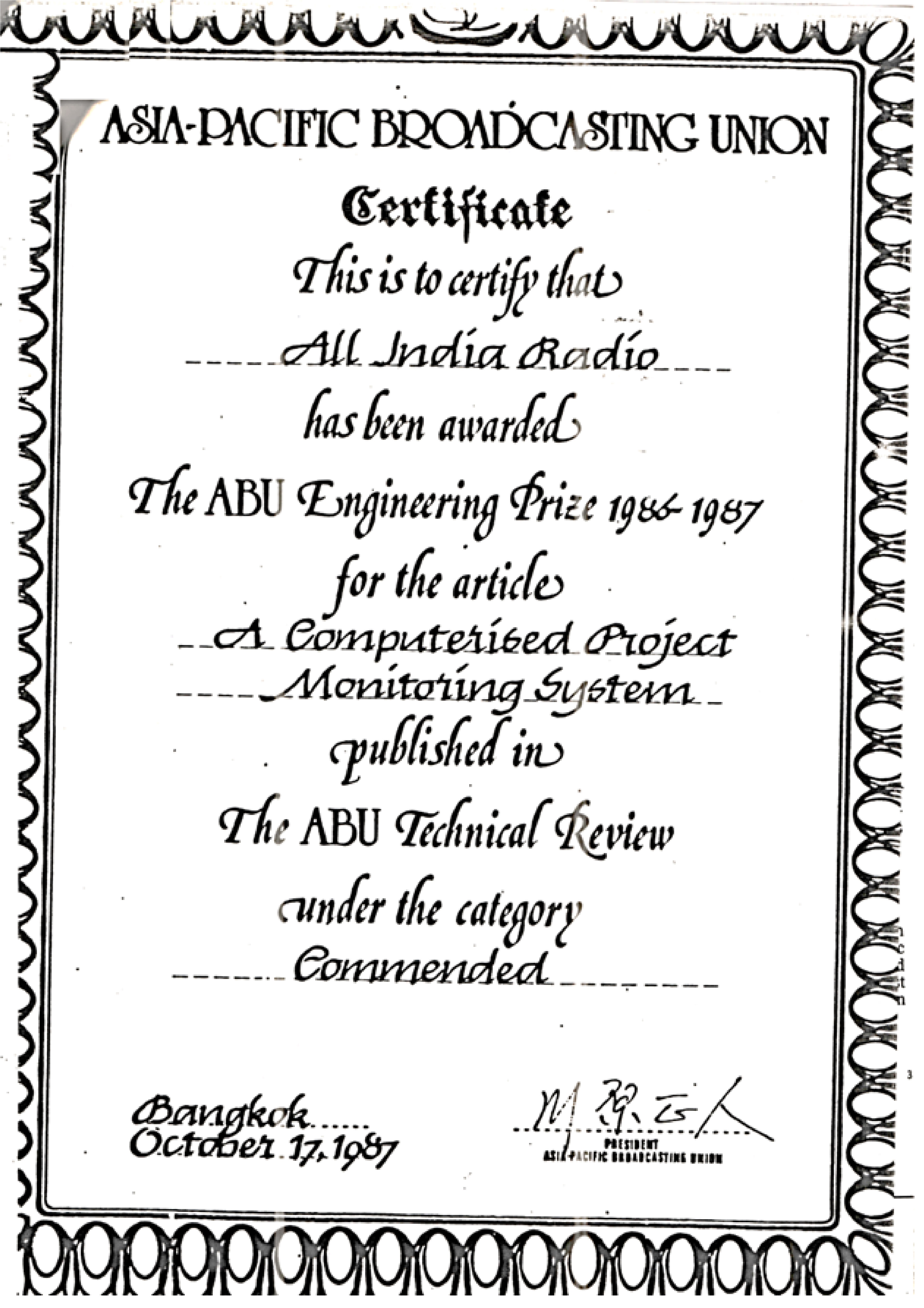
ABU Award 1987 — A Computerized Project Monitoring System
ABU Award · 1987
A Computerised Project Monitoring System
ABU Technical Review, No. 111, Kuala Lumpur, pp. 3–10, January 1987
First of its kind in Asia-Pacific · US$100 + citation
ABU Award 1988 — Integrating Computer Aided Tape Archives
ABU Award · 1988
Integrating Computer Aided Tape Archives
ABU Technical Review, No. 117, Kuala Lumpur, pp. 3–12, July 1988
First of its kind in Asia-Pacific · US$100 + citation
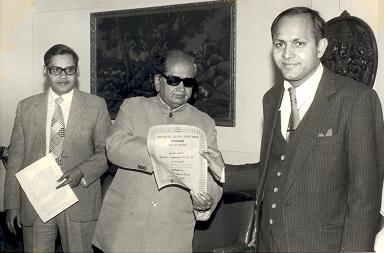
Receiving Asia Pacific Broadcasting Union Award from Minister of I&B Sh. H.K.L. Bhagat 1984
ABU Award · 1984
Award Ceremony — Received from Minister of I&B, Sh. H.K.L. Bhagat
New Delhi, 1984 · Best Prize in Asia-Pacific Region
Sixth consecutive ABU win (1984–1990)

Frequently Asked Questions

Knowledge Agriculture® was pioneered in 2018 by Prof. Dr. Sir Hari Om Srivastava (primary inventor) and co-scientist Aprajita Srivastava. It integrates Greenhouse technology, IoT (Internet of Things), Robotics, AI (Artificial Intelligence), UAVs (Unmanned Aerial Vehicles), and specialised software for weather modelling, smart zone seeding and fertiliser modelling — a comprehensive framework to address global hunger and SDG-2 Zero Hunger. It is trademarked under Scientific & Technological Innovation by the Government of India and is the subject of multiple peer-reviewed publications.
Cloud Radio® is a Hybrid Community Radio concept invented by Prof. Dr. Sir Hari Om Srivastava that incorporates cloud technology to enable two-way interactive radio-based teaching. It was implemented during the COVID-19 pandemic at institutes in West Bengal, India, enabling interactive education when physical attendance was impossible. Both Cloud Radio and the Hybrid Community Radio concept are independently trademarked under Scientific & Technological Innovation by the Government of India.
Broadcast Markup Language (BML) is a language for digital broadcasting, interactive television (ITV) and enhanced TV (ETV) invented by Prof. Dr. Sir Hari Om Srivastava. It was published in his book Interactive TV Technology and Markets (Artech House, Boston, December 2001, ISBN 978-1-58053-321-8), which foresaw interactive TV nearly two decades before it became mainstream. BML is documented on Wikipedia and the book is held at the Library of Congress, Texas State University, University of Colorado Boulder, BITS Pilani, Gonzaga University and Emerson College, among others.
"Broadcasting in the Cyberspace" (IEEE Transactions on Consumer Electronics, Vol. 44, No. 4, pp. 907–913, November 1996, DOI: 10.1109/30.555772) is a landmark research paper by Prof. Dr. Sir Hari Om Srivastava that laid the conceptual foundation for internet-based broadcasting. Published at a time when the internet was barely a decade old commercially, it is described as now widely used worldwide. Similarly, his 1997 IETE paper on Online Broadcast Archives for Interactive Video underpins modern video archiving and streaming approaches.
Prof. Dr. Sir Hari Om Srivastava is the only individual worldwide to win the Asia Pacific Broadcasting Union (ABU) Award six consecutive times — in 1984, 1985, 1986, 1987, 1988 and 1990. Each award was for a research paper published in the ABU Technical Review (Kuala Lumpur, Malaysia) on pioneering IT and computer systems applications for All India Radio. The 1984 and 1985 papers were judged the best contributions in the Asia-Pacific region and each won a prize of US$400 plus a citation.
Full-text papers are available via Google Scholar, Scopus (ID 7102601431), ORCID, ResearchGate and sirhariomsrivastava.in/Research.htm. The IEEE papers are available via IEEE Xplore using the DOIs listed above. Select papers are also directly downloadable from wdfindia.in.